
Contractor Estimate Template: Free Printable and Google Sheets
A good estimate does more than give a number. It shows the client what the price includes, what it leaves out, how long the price holds and how payment works. It also protects you, because a written scope is what you point to when the job starts to grow.
Below is a free blank estimate you can print and fill in by hand, a list of what every estimate should include, and a few notes on markup and contingency.
Free, no sign-up or email needed. Download the free PDF
Branded EZcontractordocs. Print it, copy it, use it on your jobs.
What every contractor estimate should include
- Your business details, and your license or registration number if your state requires one on paperwork.
- Client name, job address and an estimate number and date.
- Line items grouped by type: labor, materials, subcontractors, permits and fees, and disposal. Each line gets a quantity, a unit and a unit cost.
- Subtotals per section, so the client can see where the money goes.
- Markup for overhead and profit, contingency if you use it, and sales tax where it applies.
- Optional add-ons priced separately, so the client can choose without the base price moving.
- Scope of work in plain words, and a clear list of exclusions.
- How long the price is valid, the payment schedule and a signature line for acceptance.
Markup, margin and contingency, simply
Markup is the percentage you add on top of your costs to cover overhead and profit. Margin is the share of the final price that is left after costs. They are not the same number: a markup applied to cost always produces a smaller margin percentage of the final price. Decide which one you are targeting and use it consistently.
Contingency is an amount set aside for things you cannot see yet, like what is behind a wall. Some contractors show it as its own line; others build it into unit prices. Showing it openly tends to make conversations easier when something is found, as long as your contract says how unused contingency is handled.
Paper or spreadsheet?
A printed estimate is fast on site: walk the job, fill in the lines and leave a copy. The trade-off is math. Every total, markup and tax figure is worked out by hand, and that is where errors happen. A spreadsheet does the arithmetic the moment you type a quantity, keeps your unit prices consistent from job to job, and exports a clean PDF.
How to use the free template
- Print the PDF and fill in your business details once, then copy it.
- Walk the job and write each line with a quantity and unit.
- Add up the sections, apply your markup, contingency and tax, and write the total.
- Fill in the scope, exclusions, validity and payment schedule, and have the client sign to accept.
Want the math done for you?
The free PDF is the printable version of our Contractor Estimate Sheet. The full version works in Excel and Google Sheets and calculates every line total, section subtotal, markup, contingency, tax and grand total, with a payment schedule that checks your percentages add up to 100%.
Free, no sign-up or email needed. Download the free PDF
Branded EZcontractordocs. Print it, copy it, use it on your jobs.
Want the full version?
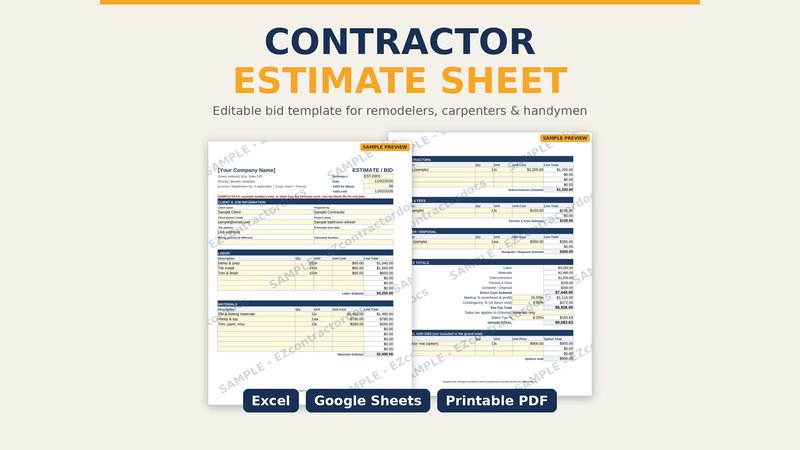 Contractor Estimate Sheet$6 · Excel & Google Sheets estimate: enter quantities and unit costs and it totals labor, materials, markup, contingency and sales tax. Printable PDF included.
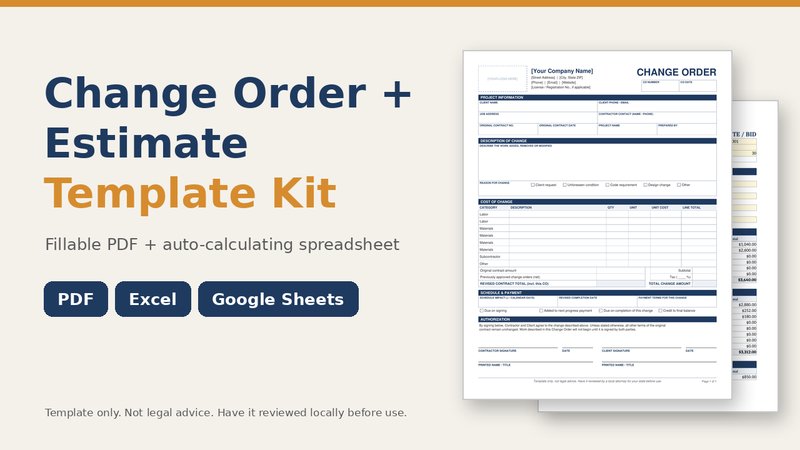 Change Order + Estimate Kit$12 · Price extra work, show the new contract total, and get it signed before you start.
Questions
Is the template really free?
Yes. Download the PDF below; no sign-up or email address is needed.
Can I use it in Google Sheets?
The free version is a printable PDF. The paid Contractor Estimate Sheet is the Excel and Google Sheets version.
How long should an estimate be valid?
There is no single rule. Many contractors use 30 days because material prices move; pick a period and write it on the estimate.
Template only, not legal or tax advice. Have it reviewed by a local attorney for your state before use. Sales tax rules for construction vary by state.