
What to Include in a Change Order
A change order is a short written agreement that changes the original contract: what work is added or removed, what it costs, what it does to the schedule, and who agreed to it. It is the single most useful piece of paper on a residential job, because most money and most arguments are lost in the middle of a project, when the plan changes and nobody writes it down.
Here is what a complete change order includes, why each part matters, and a free one-page checklist you can print and keep in the truck.
Free, no sign-up or email needed. Download the free PDF
Branded EZcontractordocs. Print it, copy it, use it on your jobs.
The 9 parts of a complete change order
- Project and contract reference. Client name, job address, and the date or number of the original contract this change modifies.
- Change order number and date. Number them in order (CO-001, CO-002) so nobody can lose track of one.
- Who asked for it and why. Client request, a hidden condition found during demolition, an inspector or code requirement, or a design change. The reason often decides who pays.
- A specific description of the change. Location, quantities, materials, brand or model where it matters. Say what is added and what is removed.
- Cost breakdown. Labor, materials, subcontractor and other costs, each with a quantity and unit price, then markup if your contract allows it, tax if it applies, and a total for this change. Credits for removed work go in as deductions.
- Contract total ladder. Original contract amount, plus previously approved changes, plus this change, equals the new contract total. This one line prevents most end-of-job billing disputes.
- Schedule impact. How many days the change adds, or "none," and the revised completion date. Write it even when it is zero.
- Payment terms for the change. Due now, with the next progress payment, or at completion.
- Signatures and dates from both parties, before the changed work starts.
Example of a clear change description
Vague: "Upgrade bathroom tile." Clear: "Per client request on the date above, replace the specified ceramic floor tile in the hall bathroom (about 60 square feet) with the porcelain tile the client selected. Includes removal of the tile already delivered, additional underlayment, installation and grout. Price difference and extra labor are shown below." The clear version tells a third party exactly what was agreed, which is the whole point.
Common mistakes
- Doing the work first and writing it up later. Once the work is done, you have lost your leverage and the client has lost their chance to say no.
- Leaving out the new contract total. A list of small changes with no running total is how a final invoice turns into a surprise.
- Skipping the schedule line. If a change adds days, the client needs to know, and so does your next trade.
- Verbal approval only. A text message is better than nothing, but a signed form is clearer.
- Mixing several unrelated changes on one form. One change per form is easier to price, approve and track.
When do you need one?
Any time the scope, price or schedule in the signed contract changes. That includes client upgrades, items removed from the job, unforeseen conditions such as rot behind a wall, and changes required by an inspector. Some contracts also require a written change order before any extra work can be billed, so check yours.
Download the free checklist
The free checklist below is a one-page printable that lists every part above with a tick box, so you can check any change order, yours or a template, before it goes to the client. If you want a ready-made form, our fillable Change Order Form covers every item, and the Change Order + Estimate Kit adds a spreadsheet that does the math.
Free, no sign-up or email needed. Download the free PDF
Branded EZcontractordocs. Print it, copy it, use it on your jobs.
Want the full version?
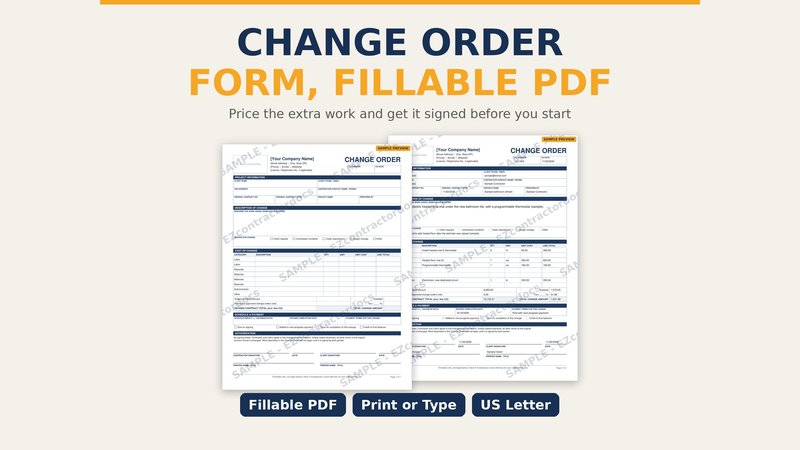 Change Order Form (Fillable PDF)$6 · A one-page fillable change order: describe the change, price it, show the revised contract total and get both signatures.
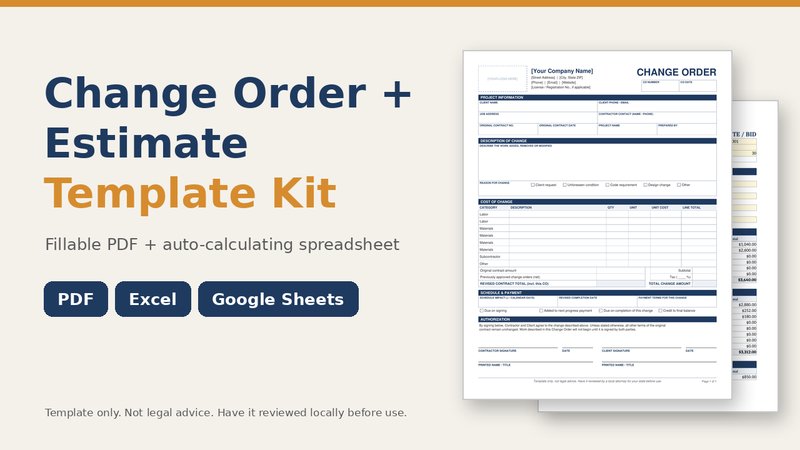 Change Order + Estimate Kit$12 · Price extra work, show the new contract total, and get it signed before you start.
Questions
Does a change order need to be signed?
Getting both signatures before the work starts is the best practice and many contracts require it. Whether an unsigned change is enforceable depends on your contract and state law.
Who pays for a change caused by a hidden condition?
It depends on your contract. Many residential contracts address unforeseen conditions directly, which is why the reason for the change is worth recording.
Can a change order reduce the price?
Yes. Removed work is shown as a credit, and the new contract total goes down.
Template and general information only, not legal advice. Change order rules depend on your contract and your state. Have your contract and change order process reviewed by a local attorney.